Brand · 1993 to 2015
Before it had a name
For twenty-two years my title said marketing. Creative director, marketing director, ecommerce manager. The work kept turning out to be the same thing: decide what the product is called, decide what the screens say, and build a way for a dozen teams to publish without breaking the system. The discipline had a name by the time I got to Kaiser Permanente. It did not have one before that.
Roles
Creative director, marketing director, ecommerce manager
Scope
Brand systems, product interfaces, CMS migrations, demand generation
The context
Between 1993 and 2015 I worked in manufacturing software, retail supply chain data, enterprise encryption, hotels, and cruise marketing. The titles were creative director, marketing director, ecommerce manager. The output was brand systems, product interfaces, websites, and campaigns.

Laid out as a portfolio, that range reads like someone who could not settle. Laid out in order, it is one job. Every engagement arrived with a marketing title on the outside and a content problem on the inside. What is this called. What should the screen say. Who is allowed to publish, and what breaks when they do.
Those are the same problems I work on now. The tools changed. The problem did not.
Act 1:A box, then a browser
MAX was manufacturing software for small factories. Scheduling, inventory, shop floor. I started on the production side at Micro-MRP, where shipping the product meant physically assembling it: disks, manuals, license, box.
Kewill Systems acquired it, and over six years as creative director I led brand through the integration of fifteen independent companies. Somewhere in there I designed the company’s first HTML browser-based interface for the flagship ERP dashboard, and set the UX foundations for their ecommerce, ERP, and data mining products. Nobody called that content design. It was just the part of the job where someone had to decide what the screens said.
The same product, relabeled


Put the two side by side. Kewill’s shell offers APS to MPS, Data Capture System, Finite Capacity Scheduling. Exact’s offers Quoting, Sales Order Processing, Advanced Shipping, Warranty Tracking. Same product, same modules, and the second one has largely stopped speaking in acronyms.
That is the smallest possible version of the work: a manufacturing planner does not think in APS and MPS, they think about quoting a job and getting it shipped. Naming the modules after the task rather than the subsystem is a content decision, and in 2004 there was no one whose job it was to make it.
Act 2:Someone had to name the screens
UDEX was a Financial Times Stock Exchange listed product data service entering the US retail supply chain market with a value proposition almost nobody there had heard of. As marketing director I ran the repositioning: the brand, a rebuilt B2B site with the agency Method, the lead generation program, Salesforce for the global sales team, and the UI strategy for the customer service portals.

That portal is product content design under another name. Items move through states, every state carries a count, the counts tell a supplier what needs attention, and a complicated submission is broken into three steps with the required fields marked. The first item on its own list of improvements was new intuitive navigation.

nCipher was enterprise encryption and key management, absorbing the NeoScale brand after an acquisition and later acquired by Thales. The brand relaunch came with a new website and a Sitecore CMS, and the reason for the CMS was governance. Regional markets needed to publish without each of them inventing a different version of the product story.

Modular zones, filled from a CMS, by people who did not build the template. That is a content system, and every argument I have had since about who owns which slot on a page started here.
Act 3:Editorial meets the booking engine
Five years as ecommerce manager for a hotel group: The Kahala in Honolulu, Makena, Embassy Suites Mexico, and properties in Napa. The Kahala’s fiftieth anniversary got a site of its own.
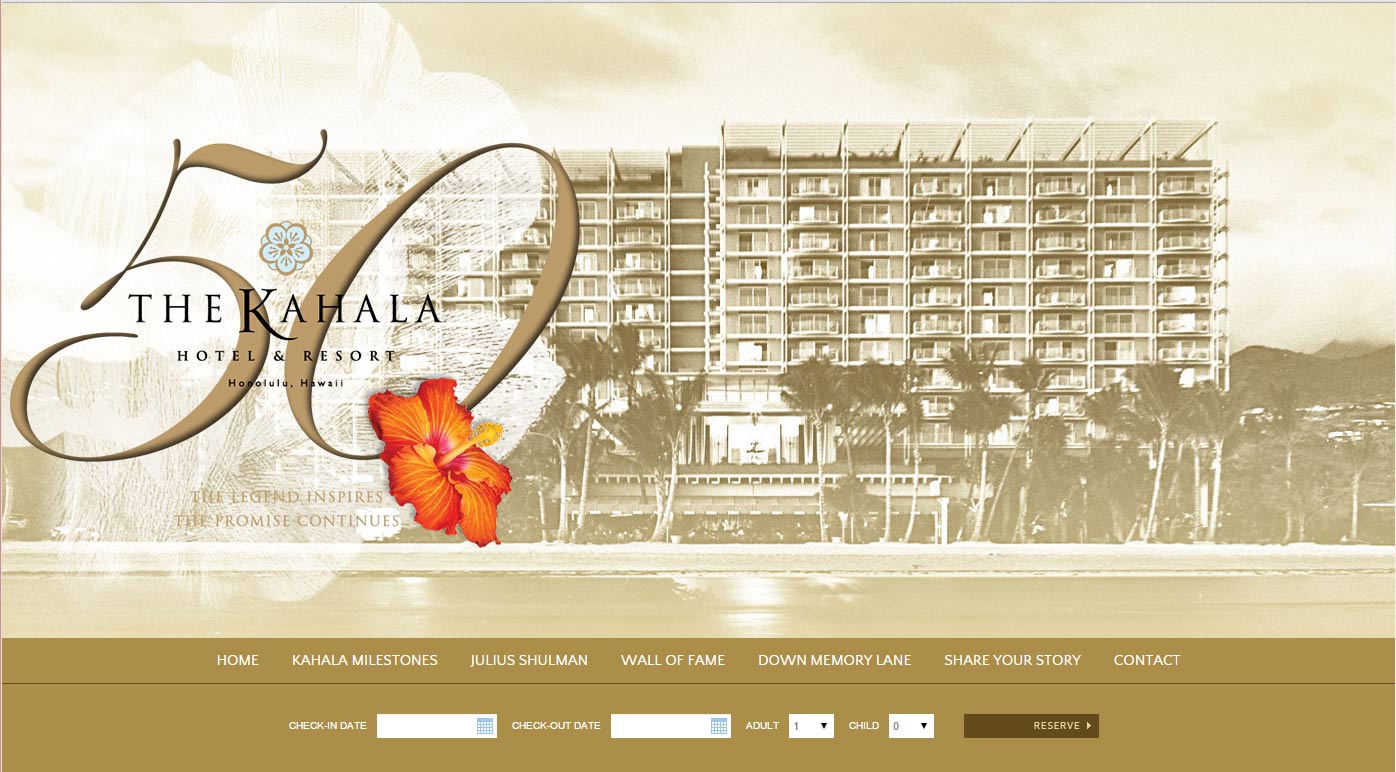
Editorial content and a booking widget in the same frame are a harder problem than it looks. The anniversary story has to earn attention and the reservation bar has to convert, and they are competing for the same few hundred pixels. Deciding which one wins, and where, is the job.
Where the section stops being brand work
In 2015 I took a short contract at Razorfish, on Holland America Line. The brief was display advertising. What the team actually proposed was a testing framework built on audience segmentation.
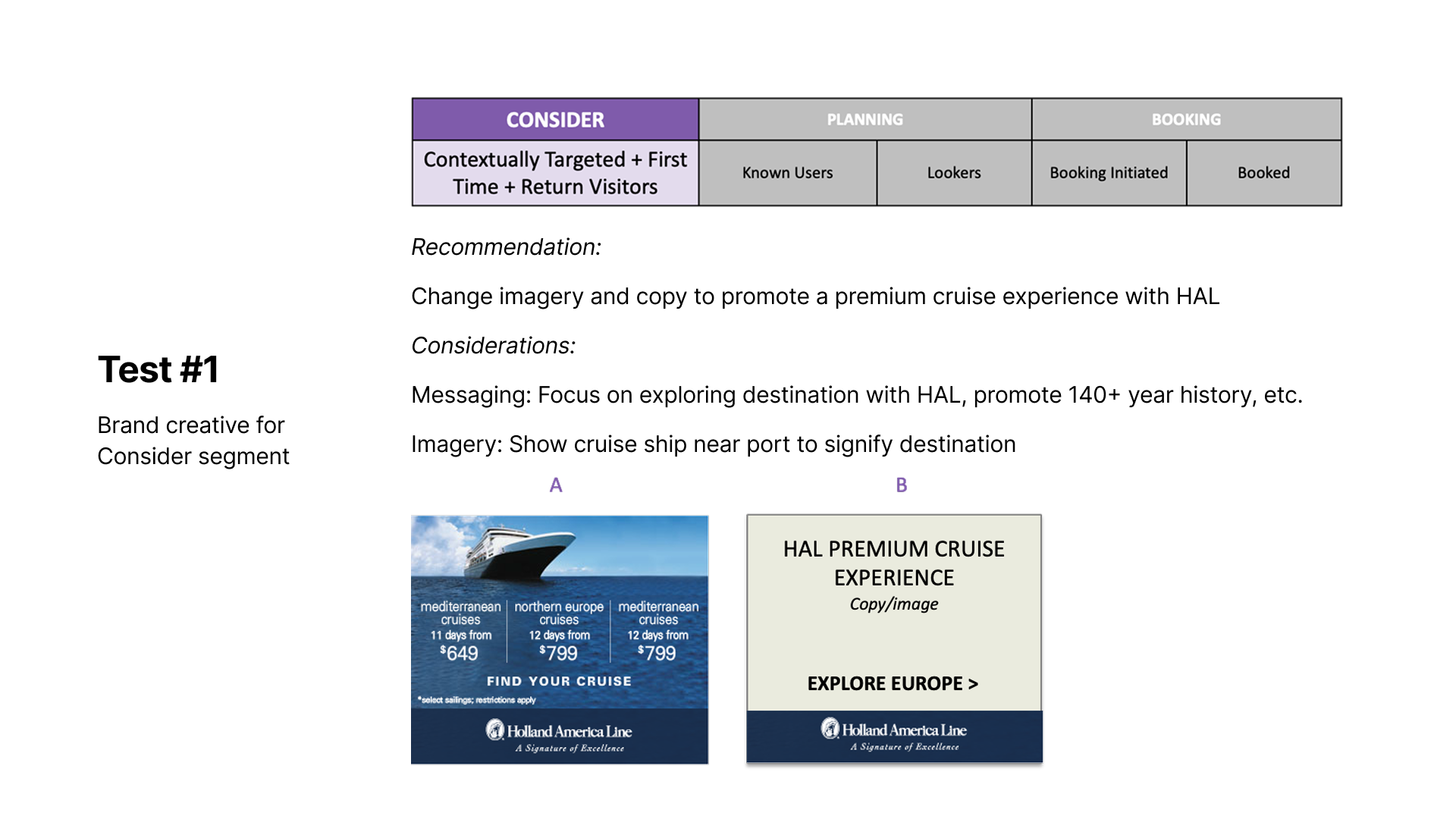
Consider, Planning, Booking, with the audience named for each stage. First-time and return visitors at the top, known users and lookers in the middle, booking initiated and booked at the bottom. Then a message written for each segment and a test to find out which one moved people forward.
That is not brand work. It is content strategy with an advertising job title on it, and it is the last thing in this section for that reason.
PostScript
Later that same year I started at Kaiser Permanente as a senior content strategist, working on content models and alert governance. From the outside it looked like a career change. It was not. It was the first time the title matched what I had been doing since the MAX box.
What carried forward is specific, and it is short. Name things so the people using them recognize the words. Structure content so a system can hold it. Build a publishing model that survives contact with a dozen teams who all want the same slot. Move a CMS without losing the meaning.
Working on something with this shape?
Naming, structure, and getting a lot of teams to publish to one system without it coming apart. If that is the problem in front of you, book some time and we can talk it through.